


Recently, I was at gorgeous Road America for an International GT race weekend. Just as I spent so much time at Mid-Ohio last month and really took a look at how to put in a good lap there, I got to thinking about the keys to making a fast lap at Road America.
With its four miles of long straightaways and sweeping corners with big braking zones that create passing opportunities, this iconic track is a favorite of mine. Here are a few key takeaways that really make the difference for a good lap there.
The first key takeaway I find is that utilizing the apex curbs correctly will help you gain a consistent amount of time throughout a lap. Despite the curbs at Road America notoriously being big and rough, using the apex curb—which is on the unweighted side of the car—can really help the handling dynamic of the car continue turning through the corner. Because it’s on the unweighted side, the curb doesn’t affect the balance as severely as some of the exit curbs do. Granted, some of the exit runoffs can certainly help the radius of your exit, but preserving car alignment and track limits are two things to consider there.
Of course, at any track, car placement is key, as we discussed previously about Mid-Ohio, which has blind crests and corners leading one into the next. Road America is very different in that there aren’t many corners that lead into the next one. And yet, car placement when setting up for a few specific corners makes all the difference.
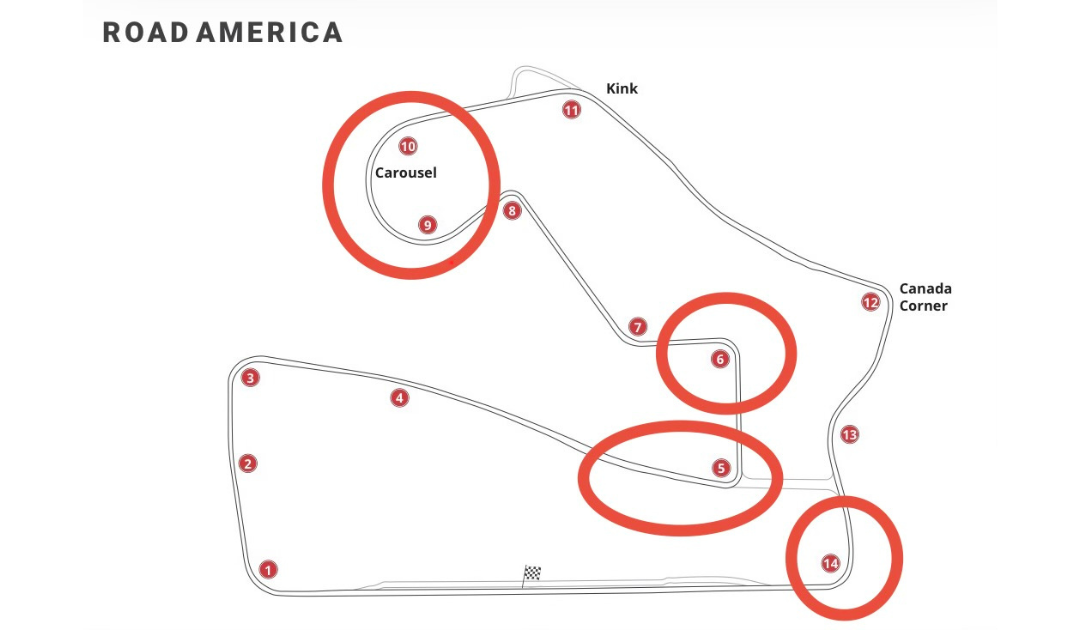
This starts with the braking for turn five. There are several variations of lines while braking for this downhill, 90-degree left-hander. No matter what line you choose to best suit your car or your racing scenario, the key is to make sure the car is fully aligned on the right side, next to the entry curb, prior to turn-in. This will allow for the optimal radius possible, starting from the entry for turn five.
Next, turn six is one of the most unique corners on the circuit, with another 90-degree left-hander, but this time, it’s totally blind as you crest the hill while braking for the corner. Plus, as the car crests the hill, the front gets light, and it’s imperative not to brake too hard in order to keep the weight of the car balanced front to rear. You need to get the front pointed toward the apex before losing the weight in the nose of the car. At the same time, you have to keep the rear stabilized, which is all about the amount of brake pressure used. Yes, it’s a tricky one!
Further on is the most unique corner on the circuit, The Carousel. Coming into this iconic corner, it’s all about the proper approach to be able to stay on full throttle as long as possible to carry the most entry speed. The signage over the bridge has changed throughout the years, which means aiming for particular letters on the sign changes with the seasons, but one thing that remains constant is running up to the entry of this corner from the far left edge and getting the car pointed just inside the center of the track, which creates a trajectory that allows you to stay on full throttle for the longest possible distance.
Lastly, the final corner, turn 14, is subtly unique in that, although it might appear to be another 90-degree right-hand bend, the road is actually turning on the approach, so the car is arcing while braking. The key here is to be aware that, because the car is already turning, you can’t brake as efficiently with the steering input. You have to be mindful of the amount of brake pressure applied to maintain the car’s balance. This also makes the car placement on entry very tricky. The driver’s eyes should be looking at the apex, but also, peripherally, at the outside of the track to optimize the car’s radius before the final turn-in.
There’s no better feeling as you chase that “perfect lap” and put it all together correctly. It’s so rewarding when it’s done right!
I’m off to Canadian Tire Motorsports Park north of the border this weekend. In the meantime, let me know which track you’d like me to dissect next!